Sunday, 28 July 2013

Blackfriars Buildings and Bridges

July 2013

I was back in my hometown -- London, Ontario -- this week for a couple of days. I'd rented a car and had an hour to spare so I decided to drive back to the neighbourhood of my youth.  Cliche, I know.  But I did it, thinking it would be the same sleepy, quiet hollow it was for the decade or more that I lived there.  But instead i ran into community concern over buildings and bridges .... Read on.

Living near the Core of London, Ontario

My early years were spent living near the core of London, Ontario, first on one side of the Thames River high on a hill overlooking the river in a post WW-II era apartment complex with tons of kids.  

When I was six, we moved to Moir Street on the other side of the Thames River, living first in one one house (left picture).  It was a rough personal transition crossing the river ... a six-year-old yanked from a living situation with dozens of kids (and even kid 'gangs') ... to just me, sitting forlornly on the steps of a new house, the only six-year old on a street of older, retired folks who rocked on their front porches every evening and worried about the lively family of 5, then 6, who moved in and took over the little street.  Apparently I went into such a black funk that my mother brought some of my playmates from the apartment complex to visit and to help me adapt.  Poor me.


A few years later, we moved next door to a larger house on Moir Street (pictured, right side of photo below).  It was larger to accommodate a larger family, had a garage and even an apple tree in the backyard. 


Once acclimated, I thrived on Moir Street, making new friends and exploring the neighbourhood.  It didn't have a formal name then but, to me, it had defined boundaries that formed a square -- busy streets that I couldn't cross on three sides of the square (Wharncliffe, Dundas and Oxford) and the river and Blackfriars Bridge bridge on the fourth side. 

The warren of tiny streets and narrow alleys was my safety zone, a playground where I walked, biked, skipped and roller skated.  The houses ranged from rundown, deserted wrecks (we were convinced some were 'haunted') to Victorian relics from the early days of Ontario history to well-manicured boxy bungalows and two-storied homes.

The neighbourhood is also shaped like a bowl.  We lived at the bottom of the bowl in what were once the flood plains for the Thames River. In fact, the area had been flooded twice in the past century before the Springbank Dam was built and a breakwater constructed along the sides of the river (in picture, left).

By the time we moved in, the area was flood-free, and I used the breakwater walls for climbing practice in the summer months.  


Blackfriars/Petersville Community


As I drove up and down the little streets last week, I was struck by signs dotting nearly every lawn:  "We love Blackfriars!  Build homes, not boxes".   Hmmm... what's going on I wondered? 

A bit of research turned up facts I hadn't known:  the area of my youth was known as 'Petersville', named after one of the original London families. In recent years, it has become known as Blackfriars Community, to honour the century-old Blackfriars bridge spanning the river.  

The signs were there to protest development plans for three houses (like the one pictured left) to tear down the single-family homes and erect 10-bedroom rental duplexes designed for students.  Rumour is that the area would go from a family to a student community.  

Organizing and lobbying by community residents have halted those development plans (at least for now).  Letters to the editor and petitions to City Council urge the City to maintain the density ratios and historic character of the area.  So far, City Council has agreed with them, and, in fact, has fast-tracked an application to make the area -- now formally known as Blackfriars -- a 'heritage conservation district' which would in effect provide the sought-after protection.

Blackfriars Bridge 

I kept going, hoping to drive over the old Blackfriars Bridge that I remembered as the fourth side of my 'square' world.  Blackfriars Bridge is located, wait for it, at 0 Blackfriars Lane.  

In my early years, the bridge both fascinated me as an idyllic wonder (like the painting, right) over the river and scared me with the clackety-clack of vehicles on the wooden boards.

Alas, there was no nostalgic trip over it this time.  The road was barricaded with signs announcing it was 'closed due to construction'.  Not even foot traffic.  

Back to a little more digging.  I was surprised to learn that it was built in 1875 and is now 138 years old, if my math is correct.  It is one of only 19 wrought-iron bridges remaining in North America and one of the few still permitting vehicular traffic.  No wonder it now recognized as a London landmark, with a heritage designation!

The bridge was closed to vehicles earlier this year for maintenance, apparently just one of a string of ongoing repairs to maintain the structure.

Ominously, the City is also considering its future and an expensive structural inspection will likely determine its fate. Community residents are watching closely for the options that Council may recommend, ranging from a pedestrian-only to more hardier repairs to support traffic. 

Hopefully, there won't be a dumb decision to have it look like its namesake in London, UK that also crosses the Thames River.  Personally, I find the UK version of Blackfriars Bridge pictured right to be pretty ugly.  Give me iron quaintness anytime! 


Monday, 15 July 2013

Japchae: Korean National Party Dish

July 2013

SmartCooks here.

Vacation, bliss.  At long last.  Time to relax, get back to the blog, learn more about international food dishes.  

A Korean dish, Japchae, is my latest find.  It means literally a 'mixture of vegetables' and is made with cellophane noodles made from sweet potato starch.  The vegetables are cooked in sesame oil and low-sodiumsoy sauce.  I would characterize it as a summer food i.e., serve it cold or warmed.  

Origins of Japchae

Japchae (also spelled 'chap chae') originated in the early 17th century, when the Joseon Dynasty was reigning in the Korean peninsula. As legend goes, when King Gwanghaegun hosted a big party at his palace, one of his lieges, Yi Chung, created a dish of vegetables to please the king’s palate. The king liked this dish so much that he rewarded his liege by promoting him to the position of hojo panseo (equivalent to the Secretary of the Treasury).  Foodie indeed.

Sweet Potato noodles were not part of the original dish but made their debut in the early 20th century.  The long noodle (called 'danymyeon) symbolize long life/long happiness so purists do not cut them.


Today, Japchae is usually served at parties and special occasions like weddings and landmark birthdays. It's also popular street cart food.  At Korean restaurants, it is often served as a side dish or "banchan".  It can be made with beef/chicken/tofu or just with vegetables.  

'Doing the Carb Count":  Sweet Potato Cellophane noodles


Ever curious about 'better carbs', I googled 'sweet potato' vs 'pasta' noodles with some surprising results.  The good news is that the noodles are gluten-free, low sodium and contain no fat, a big plus for many.   But, not surprisingly, they have about the same calorie/carb count as whole wheat pasta, meaning about 170 calories in a portion of noodles and 43 grams of carbs.  Nonetheless... for a treat... 


Cooking the Dish


The vegetarian version from Savoury and Sweet Life was straightforward (the author was a guest blogger at Herbivoracious, photo at left).  There are a few guidelines for preparing the dish i.e., 

Noodles:  They should look translucent but still be pliable.  Don't overcook them.  

Vegetables:  The most common (so ones I tried) are shiitake and oyster mushrooms, onion, spinach (Korean or North American variety), carrots, bell peppers, green onions and garlic. 

Preparation:  Everything should be thinly sliced, either with a knife or julienned with a mandoline. 

Must-have's:  Everything is mixed with some soy sauce (less sodium), sugar, sesame oil, pepper, and sesame seeds.


If using beef or chicken, the best recipe was from a blogger called Beyond Kimchee, which follows the same guidelines as above but includes instructions for cutting meat into small 2 inch long by 1/4 inch thick pieces, marinading it and then adding it to the noodles.  Recipes for the vegetarian and meat versions of Japchae are given below.  

It's too hot and humid here in Ottawa (42 degree C and rising) to even consider cooking or eating anything today but there's always tomorrow!  And judging from the political events playing out today, I've cancelled holidays in C'Town this week and am back to the A/C at work for briefings.  Enjoy!  

Japchae Recipe
(Inspired by Sweet and Savoury Life, Herbivoracious and Beyond Kimchee blogs) 
Serves 2-3 as a main dish

Ingredients:

1 bundle of potato starch cellophane noodles (packages contain 2-3 bundles)
2 cups of fresh spinach
1/2 medium yellow onion, julienned
1 carrot, peeled and cut into match sticks
1/2 red bell pepper, julienned
8-10 fresh shiitake mushrooms, sliced
2 stalks green onions, sliced in 1.5” slices (green parts only)
½ block of firm tofu, cut into small rectangle pieces (approx. 1.5”x1”x1/4”)
2 cloves garlic, minced
Olive or Canola oil
LIght soy sauce (amounts will vary, see directions)
Sesame oil (vary amounts in directions)
Salt and pepper
2 T sugar
3 T toasted sesame seeds

Directions:

Noodles:  Boil one bundle of noodles for 5 minutes until softened and al dente in texture. Drain the noodles and do not rinse. Add noodles to a large bowl and cut them three times with kitchen shears (or not).  Add 2 T (each) of low-sodium soy sauce and sesame seed oil. Toss noodles until sauce is evenly distributed.  Set aside. 

Spinach:  Using the same pot as the noodles, add enough water to boil spinach for 1 minute. Remove spinach from water and allow to cool just enough to squeeze as much water out as possible. Cut spinach in thirds, and massage it while seasoning with 1 tsp of sesame oil and a pinch of salt and pepper. Add spinach to the noodles.

Vegetables:  Heat a wok or large frying pan on high. Add 1 tsp of olive or canola oil and cook and stir sliced onions for 2 minutes. Season with 1/2 tsp of sesame oil and a pinch of salt and pepper. Add onions to the large bowl of noodles. Repeat the same process as the onions except reduce cooking times to 30 seconds for the carrots, 2 minutes for the bell red pepper, 1 minute for the shiitake mushrooms, and 10 seconds for the green onions.

Tofu:  Fry tofu squares for 1 minute per side – but do not add to the bowl of noodles. 

Assembly:  Add 2 T of low-sodium soy sauce, 1 T of sesame oil, 2 T of sugar, and ½ tsp of pepper to the noodles and toss everything until well mixed.  Add 1 T of olive or canola oil to the hot wok and add minced garlic. Allow garlic to cook for a few seconds and add the entire bowl of mix noodles and vegetables to the wok/pan. Stir-fry everything for 2-3 minutes and turn off heat. Gently add tofu and transfer noodles to a large serving platter. Sprinkle toasted sesame seeds on top. Serve warm or cold.

Meat versions:  Cut beef or chicken into strips of 2 inches long x 1/4 inch thick.  Marinade meat in 1 T low-sodium soy sauce, 1/2 T sugar, 1 T rice wine, 1 tsp chopped garlic, 1 tsp sesame oil, and 1/4 tsp pepper.  Saute in hot wok a few minutes, then remove.  Keep sauce in pan and add noodles and vegetables to it and stir fry.  


Saturday, 6 July 2013

Picnic-Pick Pickled Vegetable Slaw with Mustard Seeds

July 2013

SmartCooks here.

I overbought at the Farmer's Market last weekend.  No surprise there.

It meant of course that before setting off for another week in Charlottetown, I was faced with the choice of either 
a) bringing a plastic bag of fresh vegetables and a freezer pack in my carry-on luggage; or 
b) making pickled vegetables that last up to a month in the refrigerator.

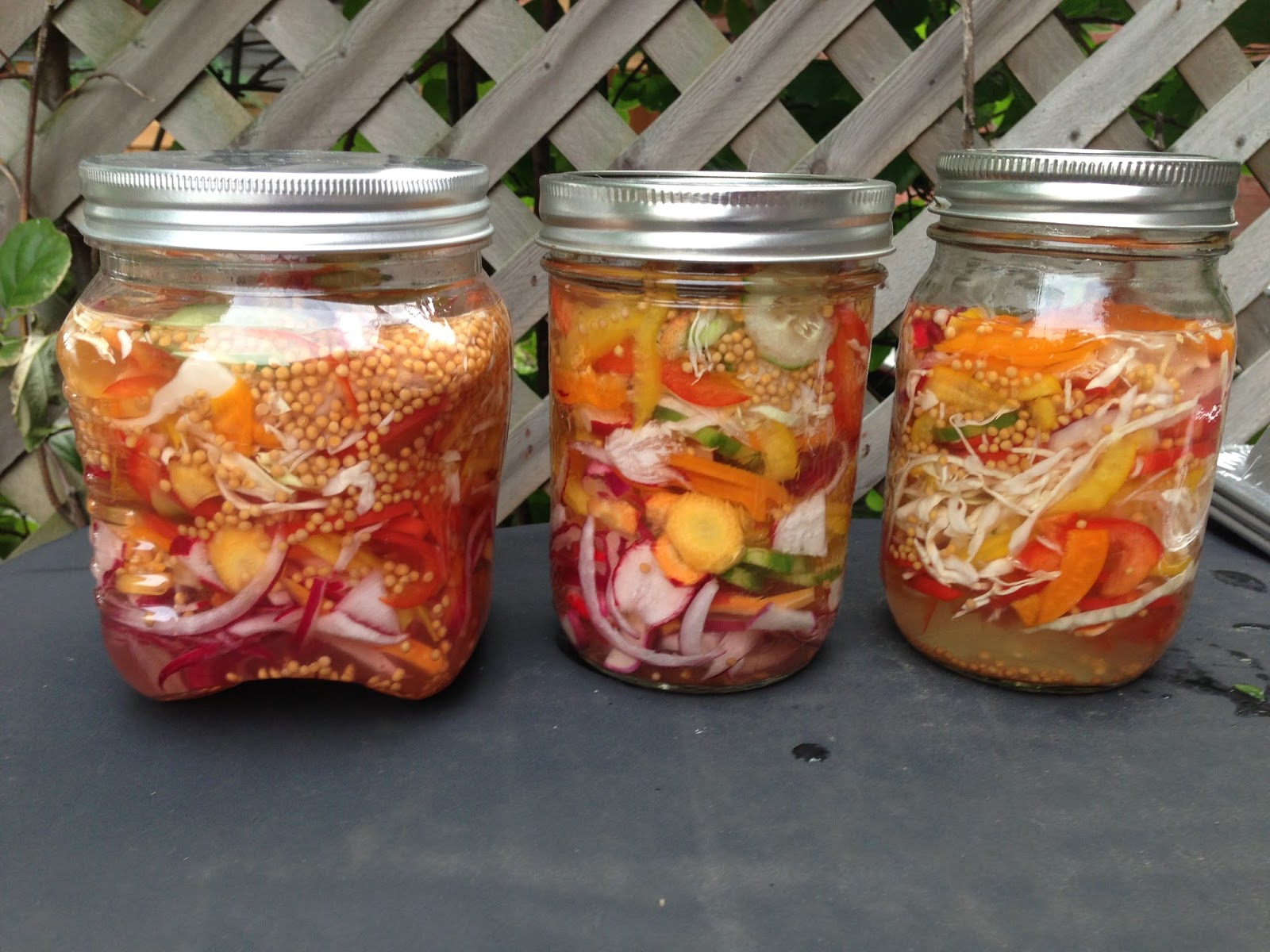
I chose b) and made 3 batches of vegey slaw earlier in the week.  

Smart choice.  

Upon my return from C'Town Friday night, delightfully crunchy fresh pickled vegetables awaited me, making it super simple to pull together a light dinner of zesty lime chicken sliders (with a dash of vegetable slaw) and a watermelon and cumber salad.  Excellent... fast... low fat.

What inspired me was a Smitten Kitchen posting where Deb vows that doing this was fast, easy, and crunchy without the mess and bother of canning and sterilizing.  Sold.

Plus, you could use any combo of vegetable on hand to make the slaw.  Particularly crunchy are radishes, bell peppers (of any colour), carrots, sugar snap peas, kirby cucumbers, cabbage, parsnips, zucchini, red onion.  she warns against adding red radish because the red colour bleeds into the other vegetables. I ignored this advice and went with red radishes and so far, all is good.

The only potential hassle with this recipe is cutting up all the vegetables.  I saved time and used a mandoline with a julienne blade.  I have a julienne peeler but in the interest of time went with the fast route.  A knife works just as well. Just get 'em all into skinny matchstick size. 

The vegetables will be lightly pickled within an hour, and done in a day. They will last for weeks in the refrigerator as long as they stay immersed in the brine.  

The slaw is coming with me this weekend as we head out into the (finally!) July type weather for a bike ride/picnic/farmer's market visit.  Definitely my pick for fav picnic-friendly fare!   Enjoy! 

Picnic-Pick Pickled Vegetable Slaw with Mustard Seeds
(Inspired by Smitten Kitchen) 

Pickling mixture1 cup distilled white vinegar

4 T sugar
2 T Kosher salt
2 T yellow mustard seeds
1 cup cold water
Vegetable Slaw mixture
4-5 cups mixed julienned firm, raw vegetables (from list above)
Jalapeno or Bird's eye chili slivers (optional)

Directions:
Bring vinegar, sugar, salt and mustard seeds to a simmer in a small pot over medium heat, stirring only until sugar and salt dissolve. 

Stir in water and let cool to lukewarm.  Divide vegetables between jars. (I used 3 jars).  Pour vinegar mixture over vegetables and refrigerate. 

Sunday, 16 June 2013

Vietnamese Cabbage, Tofu and Herb Salad (Herbivoracious inspired)

June 2013

SmartCooks here.  

Vietnamese Cabbage, Tofu and Herb Salad or Gói Bắp Cải Dậu Phụ started out as a May Day dish from one of my favourite websites Herbivoracious and ended up as a staple for the month of May.  Various combos of meat, herbs, and vegetables ... tofu, chicken, crispy fried shallots or not, roasted peanuts, roasted sunflower seeds, mint, cilantro ... whatever I had on hand.  All of them simple, one bowl meals


The reason for the variations on a food theme? 

Easy.  May went by in a blur. 

Work, flying back and forth between Ottawa and Charlottetown in very small prop-plane aircraft (inside a 'Flying Coffin', pix at left), moving to another rental apartment in Charlottetown, home stuff, community vegetable garden venture, friends celebrating milestone birthdays and retiring from the public service, not to mention kids of friends having baby showers and weddings. (Yeah to all of them!)  Pix below and on Facebook chart the May mayhem.  


All to say it's now June in Ottawa (and elsewhere) and NO spring.  Crummy weather is the norm.  One nice day like yesterday morning early in PEI from my balcony (pix right) and then back to dreary, dark, rainy days.  I've got a few more weeks of work frenzy and then hopefully holidays and a bit of a respite. 

Given all the activity in my life, I've been looking for simple, nutritious and interesting foods to prepare.  A Vietnamese dish with cabbage, tofu, herbs and shallots fits the bill.  Besides, it gave me something to research while sitting in airport lounges with all my technology plugged in around me.


Thankfully, I've earned enough brownie points from Air Canada to get some perks without having to pay more than economy (austerity and all) i.e., access to the lounges where I can huddle and write in a corner. 

Or it may be because some Air Canada security video caught me on tape a few months back where I was delayed for hours at a departure gate in Toronto.  It led to the rather sad/funny sorry sight of a middle-aged plus woman (aka me) scrabbling about on the floor to surreptitiously reach behind a security barrier and plug in a dying cell phone to deal with whatever work mini-crise was happening at work.  Soon someone will invent a way to recharge all these devices wirelessly without any cords.  

Vietnamese herbs 


Vietnamese cooking uses herbs in abundance.  

The term for herbs is 'rau thom' meaning 'fragrant leaves'.  Every Vietnamese recipe I've found so far calls for a variety of herbs such as:

-- Cilantro-like herbs (rau rum) and mint (hung coy) are spicier and stronger than those found in North America.  

-- Common Viet herbs also include Tiao to (red perilla), rau thom (sorrel), balm and thi la (dill).  

-- Some frequently used herbs are green on top with purpose underneath and offer a hint of cinnamon, mint and lemon.

If I lived in Orange Country, California, I could zip down to the Saigon market (below) where vendors sell the full range of herbs.  However, living in Canada means substituting so cilantro, mint and dill are usually my staples for these dishes.  


Vietnamese Cabbage, Tofu and Herb Salad
(Herbivoracious inspired)

Ingredients:
5 large shallots, peeled and thinly sliced
Vegetable oil for frying
3 ounces extra-firm tofu, 1/4" dice (or chicken or pork)
Kosher salt
1/2 small head green cabbage, cored, thinly shredded and refrigerated
2 big, packed handfuls mixed Vietnamese herbs - rau ram, mint, cilantro
2 T lime juice or rice vinegar
1 tsp sugar
1 T soy sauce
1 tsp minced fresh ginger
1 clove garlic, minced
1/4 cup peanuts, toasted and lightly crushed
Directions:
Bring a small pot with oil (I use either grapeseed or peanut oil) to completely cover the shallots up to a low frying temperature, about 260 F / 126 C. Add the shallots and cook, stirring occasionally until deeply golden brown. This can take a very long time - around 45 minutes. I've been known to up the temperature and cook the shallots faster as long as you watch them carefully. 

When the shallots are done, drain them but reserve the oil. Spread the shallots out on paper towels. As they cool, they become very crispy.
Pan-fry the tofu in a small amount of oil until nicely browned. Transfer to paper towels and season. (If using meat, do the same).
In a small bowl, stir together the lime juice, sugar, 1/4 tsp salt, soy sauce, ginger, and garlic. Whisk in 1/4 cup of the reserved shallot oil. 

Put the cabbage in a mixing bowl. Add half of the shallots, the tofu (or meat), and all of the herbs, tearing them. Add the dressing a little at a time and toss with tongs, until the cabbage is well dressed but not drenched. Taste and adjust seasoning - it may need more salt. 

(If adding in extra vegetables, like asparagus or zucchini or even leeks, I cook or blanch them and add them to the salad at this point.)
To serve, transfer the salad to platter. Garnish with the remaining fried shallots and peanuts. 


Sunday, 14 April 2013

Preserving Lovely Easter Dinner Memories

April 2013

SmartCooks here.  

I wanted to preserve the Easter dinner menu for posterity and thanks to photographers Jane and Michael.  If I don't write it up now, I'll never remember what I did next year.  What I won't forget though is the fun of having good friends and family for dinner.  

Easter 2013 menu

Appetizers

Just two of them, each one quite different and meant to appeal to the range of appetites ... vegetarian or not.  


Bacon-wrapped dates stuffed with blue cheese

Variations on this recipe are endless.  They can be made ahead of time and cooked at the last minute -- 20 minutes in the oven or under the broiler.  

The only ingredients are Medjool dates (ideally), pitted, stuffed with crumbled blue cheese (or something else of your choice if blue cheese is not your thing), and wrapped in half a slice of bacon.  The morsel is then secured with a wooden toothpick (guess who tried multi-coloured toothpicks and then remembered, at the last minute, that plastic is not oven-friendly.... sigh) and then cooked in the oven.  This is Husband's favourite appetizer, along with BBQ chips.  sigh.  

Vegey trap with dip 


There are so many great designs for vegey trays.  I went geometric this time and copied the design onto a tray and made a low-cal dip.  It was fun and easy to make and a delight to show.  


Main Event:  Ham with Pineapple and Cloves

I pre-ordered a bone-in ham from Glebe Meat Market and specified enough for 7-8 people, with no leftovers.  I must remember next year to say 'leftovers' as it was one of the best hams I've ever cooked.

For some reason, I'd never cooked ham with pineapple and clover before (not sure why) so I patiently watched the videos showing me how to do a diamond pattern across the ham and where to place the cloves (at the apex of a diamond).  

The video chefs made it look incredibly easy.  Me... well, I obviously need a boot camp at Greco's or better knives.  It was a frigging nightmare sawing away on the ham to get the diamond pattern right.  One slip and I knew my finger (and dinner) would be toast.  

The ingredients were standard (pineapple, brown sugar, cloves) but with one weird item -- a lemon-lime flavoured carbonated beverage.  Nonetheless, it worked like a charm. Husband did the basting every half hour or so but It then cooked far faster than the published time.  End result was simply superb.  Pineapple, both cooked and on the side, was a welcome addition.  Allrecipes was ace.  

Scalloped Potatoes

Two versions of this scalloped potatoes were prepared by Chef Fred -- one with cheese and the other without.  Both were hits... they disappeared pronto.  Will ask him for the recipe for next time.

Salad:  Mixed Baby Greens with Mandarin Oranges


Photographer Michael captured this gem of a dish on a plate that was a present from the friends-next door neighbours.  It certainly shows off the mixed baby greens and mandarin oranges to advantage.  It appealed to those who aren't big fans of vegetables (and you know who you are....)

Food Network (Rachael Ray) prepared a version of this dish which I adapted.  Greens, cucumber, oranges, rice wine vinegar, toasted sesame oil and sesame seeds all put together at the last minute to keep it super fresh and perky.  

A keeper for sure...


Sides:  Asparagus with Balsamic Tomatoes 

Cooking Light featured this dish in a special on low-fat Easter dishes.  It rocked the table, with lightly blanched asparagus drizzled with balsamic vinegar.  Grape tomatoes provided great colour contrast and the final touch -- dots of crumbled goat cheese -- completed the picture.  

There are intriguing variations for future experimentation -- e.g., raisins and pine nuts, sesame-ginger glaze or lemon-tarragon dressing.  


Green and Yellow Beans with Red Peppers 

Kalyn's Kitchen inspired a version of green and yellow beans, laced with red peppers, and spiced with ginger.  

It was the perfect green for the anti-asparagus crowd at the table. 


Cumin-Orange Root Vegetable Slaw 

If it were just me cooking and eating dinner, my preference would be ham, pineapple and a root vegetable slaw.  The Kitchn showed me a version I couldn't resist -- beets, celery root, carrot tossed in a vinaigrette of cumin, orange and sherry vinegar.  

It was a lot of chopping, done ahead of time, but the end result was pleasing to both eye and palate.  


Bread

Irish Soda Bread it was.  Recipe posted previously. 

Dessert:  Hazelnut Torte Bomb (without the e) 


I saved the worst for last. I experimented.  I goofed.  It reinforced my antipathy to making desserts which I was determined to conquer. I failed.  I will rise again.  Oh well, the home-made ice cream on the side made up for it.  

Smitten Kitchen raved about this torte, saying it was the best thing ever to come out of her kitchen.  I read the recipe many times. Seemed straightforward.  

First, I ran out of hazelnuts.... Easter morning there's not much open and Husband's expedition trip turned up nada.  Undeterred by this ominous sign, I googled 'substitutes' and found some tepid suggestions to use almonds.  So the last third of the required amount was almonds.  I don't think they added to the taste.  

Then, I laid out the hazelnut/almond layers, spread a layer of chocolate, cooled them outside for 20 minutes, brought them back in and stacked them up one atop the other.  Hmmmm.... by layer three I knew something was amiss.  The cake looked nothing like the picture ... flat and lopsided.  Hmmm.... I re-read the instructions.  Yup, I missed a crucial step of putting white whipping cream on top of the chocolate BEFORE adding the next layer.  sigh..

I managed to peel away two of the three layers and start again but one layer just wouldn't cooperate.  After a few 'darns', I stuck it all together as best I could and smushed the rest of the topping around the cake covering over the boo-boo areas.  I then shaved chocolate on the top and stood back to take stock. 

End result:  lopsided, with a few dents in various spots, not as high as adverted in the photo, and generally a little sad and droopy.  The taste was OK but with a sharp taste of hazelnuts which I think was caused by the almond mixture.  

Verdict.  Guests were kind.  They ate and poured another glass of wine or water.  

Next time.

Despite the dessert bomb, all in all.... Fabulous evening. 

Saturday, 13 April 2013

Discovering Korean Bibimbap and savouring it in Ottawa

April 2013

SmartCooks here.  

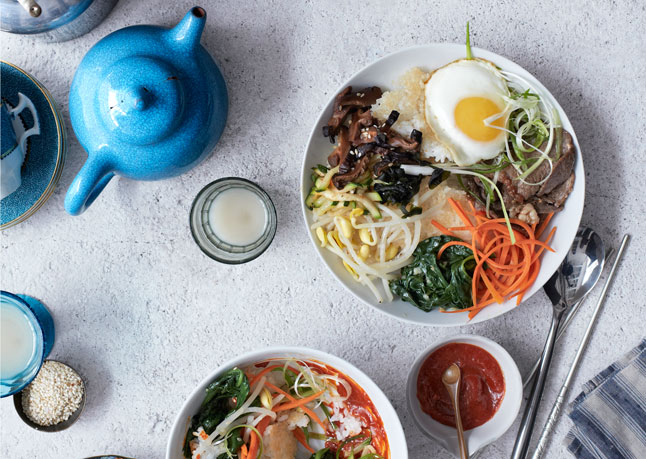
I took a savoury trip safely to Korea thanks to the Internet, Bon Appetit, and a small Korean supermarket I found in Ottawa not far from my house.  My mission:  to cook Bibimbap, literally 'bibim' (mixed) and 'bap' (rice).   

I researched, I shopped, I prepped (a lot!), I cooked, I hummed "put 'em together and what have you got... bibimbap-ity, bibimbap-ity, bibimbap-ity-doo")  And then I ate .... a feast of noodles (not rice), beef bulgogi, and a variety of vegetable 'mix-ins'.  The dish has endless variations, and can easily be made vegetarian-friendly. 

Origins of Bibimbap

As I researched, it was clear there was centuries of thought behind this dish, with careful attention to taste, harmony, balanced appearance and healthy, umami eating.  


The ingredients are chosen based on the 'ying' and 'yang' and the Five Elements Principle:
--- Rice (sweet) 
--- Chungjang (salt)
--- Sesame Oil (savoury)
--- Gochujang (spicy) 
--- Kongnamul (bitter) 

Vegetable mix-ins can be your choice but should be blanched, lightly sateed and seasoned.  Try to follow the colour wheel and umami principles:  dark green spinach, orange julienned carrot, white daikon radish, red bell pepper, mushrooms, cucumber, bean sprouts, dried seaweed etc.  

Legend has its that Bibimbap originated in Jeonju in South Korea, an important tourist centre for the best in Korean food.  In 2011, in a CNN Travel poll, Bibimbap was listed at number 40 on the World's 50 most delicious foods.  A version of Bibimbap, or a dish called Dolsot Bibimbap, is served in a very hot (hissing!) stone bowl in which the rice is cooked, then topped with vegetables, beef, egg and hot red pepper paste.  The rice crisps up in the hot bowl and is part of the fun of the dish.

Its popularity continues to rise today as Western cultures discover the umami nature of the dish.  At right is a photo of an event to showcase the dish.  The bowl measures 2.5 m in diameter, contains 200 kg of rice and 10 kinds of vegetables --  enough to serve up to 1,000 people.

Bibimbap Ingredients


For the recipe I chose to use as a base -- from Bon Appetit -- there were two ingredients I needed from the local Korean supermarket -- Gochujang (Korean hot pepper paste) and Gochugaru (coarse Korean red pepper powder).  I goggled 'Ottawa Korean supermarkets' and found it only several blocks away from my house.  It is a small, run down, jumbled kindof place on Bank Street, not at a glance the type of store I'd explore on a whim.  But it was quick and easy.  I simply pointed to the photos of the ingredients I needed and I was out in five minutes.  

Gochujang or Korean hot pepper paste is pictured at left. 

The store carried medium strength, which was  was perfect for my dish.  It's obviously the Korean version of Sriracha but not nearly as hot.  I've read it's rivalling Sriracha in popularity.  It has my vote.  


The other ingredient was Gochugaru (coarse Korean red pepper powder).  The colour of deep red sprinkled lightly on vegetables gives a nice, pleasing appearance. Used lightly, it has only a very slight bite to it.  

I added beef bulgogi to the dish for husband in particular.  I've featured recipes for this in previous blog postings.  The seasoning of soy and ginger on very lean beef adds a distinctive flavour to the dish.  In this posting, I'm using the Bon Appetit version of beef bulgogi. 

The final topping for the dish is an egg.  Tradition is that it is a raw or very runny egg.  I don't do raw so made a fried but still runny egg.  Then assemble the rice or noodles in a bowl, top with vegetables and sauce, then the egg, admire how it looks, stir it all together and Bibimbap it is.  

Bottom line:

Plan ahead for this one, organize all ingredients beforehand, conscript the chopping helpers and enjoy!  A savoury and safe trip to Korea. 'Bibim-bap-ity doo...'  


Bibimbap recipe
(with recipes for some of my favourite vegey mix-ins) 

Beef Bulgogi and Rice OR Noodles 
Ingredients:
1/2 cup reduced-sodium soy sauce

1/3 cup finely grated Asian pear with juices

2 scallions, thinly sliced

2 garlic cloves, minced

1 T brown sugar

2 tsp grated peeled ginger

1 lb thinly sliced (1/8-inch) boneless beef rib-eye steak or short ribs


Rice or noodles of choice.  
1 fried, runny or raw egg 

Directions:
Whisk first 6 ingredients in a medium bowl.  Add beef, toss, cover and chill for 30 minutes or up to 3 hours.  

Prepare rice or noodles and set aside.  There are recipes on line for crispy rice which I did not do. Add egg as last ingredient.  

Vegetable Mix-in Recipes:  Sesame-Pepper Bean Sprouts, Sesame Carrots, Garlicky Spinach (not baby spinach), Soy-Glazed Shitake Mushrooms, Sauteed Zucchini, Scallion Slaw, Gochujang Date Sauce. Other ingredients can be wakame (seaweed), snow peas..


Ingredients for vegey mix-ins:
- 6 cups mung bean sprouts
- 4 medium carrots
- 2 10-ounce bags fresh spinach
- 3 cups dried shitake mushrooms (3 ounces) 
- 1 medium zucchini 
- 2 bunches scallions
- 5 pitted Medjool dates (for the sauce)

Other ingredients you will need:  Toasted sesame seeds, reduced sodium soy sauce, white vinegar, brown sugar, Gochugaru (Korean red pepper powder), kosher salt, freshly ground black pepper 

Directions for Vegetable Mix-ins (Bon Appetit style):

Sesame-Pepper Bean Sprouts:  

Mix 2 T toasted sesame seeds, 1/2 tsp kosher salt, 1/4 tsp freshly ground black pepper in a bowl. Set aside.  Cook 6 cups mung bean sprouts in boiling salter water for 3-4 minutes.  Drain.  Transfer to a medium bowl.  Add 2 tsp toasted sesame oil, toss to coat.  Add in sesame mixture. Season with gochugaru (Korean red pepper). 


Sesame Carrots:  

Cut 4 medium carrots into long matchstick-size pieces.  Heat 1 T toasted sesame oil in a large skillet, on medium heat.  Add carrots, sauté 3-4 minutes.  Season with salt and pepper.  
Garlicky Spinach

Cook spinach in a large pot of boiling, salted water 1-2 minutes.  Drain, transfer to a bowl of ice water to cool.  Drain, squeeze out excess water.  Heat 2 T toasted sesame oil in a large skillet on medium heat.  Add 2 garlic cloves.  Stir 1 minute.  Add spinach, 2 T reduced-sodium soy sauce and 1 tsp distilled white vinegar.  Stir and season with salt and pepper.  


Soy-Glazed Shiitake Mushrooms:  

Bring mushrooms, 1/3 cup reduced sodium soy sauce, 1 T brown sugar and 1 cup water to a boil.  Cover, reduce heat and simmer, 12-15 minutes.  Let mushrooms cool, then slice.  Transfer to a small bowl, add 1/2 tsp toasted sesame seeds and pepper.


Sauteed Zucchini:  

Cut 1 medium zucchini into matchstick-sized pieces.  Heat 2 T toasted sesame oil in a large skillet, on medium heat. Add zucchini, cook, 3-4 minutes.  Season with kosher salt, pepper and gochugaru (Korean red pepper powder).


Scallion Slaw:  

Cut scallions into 3-inch lengths, then slice lengthwise thinly.  Place in bowl of ice water.  Just before serving, drain, pat dry, and transfer to another bowl.  Add 1 T white vinegar, 1 T toasted sesame oil and toss to coat.  Season with salt, pepper and gochugaru.  


Gochujang Date Sauce:  Put 5 pitted dates in a small bowl, cover with boiling water and let sit for about 10 minutes.  Drain, transfer dates to a food processor.  Add 1 cup gochujang (Korean hot pepper paste) and 2 T toasted sesame oil.  Puree until smooth.